Download FROG Presentation with Narration (77MB)!

Spatio-temporal distortion measurement talk (13MB)

Dr. Rick Trebino's Book:
"Frequency-Resolved Optical Gating: The Measurement of Ultrashort Laser Pulses"


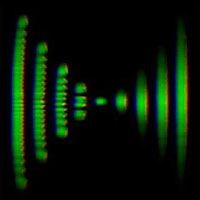
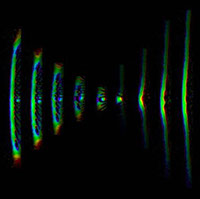
Our paper about measuring Bessel-X pusles was featured in OPN's December issue "Optics in 2009".

Our recent invention, GRENOUILLE, has won a 2003 R&D 100 award.
(see the cover of R&D100 magazine)

FROG (Frequency Resolved Optical Gating) is a technique that completely characterizes an ultrashort laser pulse in time. Since its introduction about a decade ago, FROG has evolved into a fairly general and powerful technique for measuring ultrashort laser pulses. But to become truly useful, any optical technique must go beyond the measurement of mere laser pulses, whose intensity and phase are well-behaved in space, time, and frequency and have fairly high intensity. It will need to be able to measure light pulses, whose intensity and phase are not so well-behaved in space, time, and frequency, and which often aren't all that intense. For example, we'd like to be able to measure ultrabroadband light pulses from micro-structure optical fiber and ultraweak luminescence from molecules important in biology and human physiology-light pulses whose measurement will lead to new technologies or teach us important things about life, not just how well our laser is aligned.

And we'd like to do so with confidence in our measurements. This necessarily means a simple device, not one so complex that it could easily cause the same distortions it hopes to measure. The goal is not a complex device that can only measure simple pulses, but a simple device that can measure complex pulses.

We are making good progress, and recent developments include techniques for measuring light pulses that are extremely weak, have poor spatial coherence, have random absolute phase, have spatio-temporal distortions, and/or are extremely complex-and our devices are quite simple. In addition, we are using FROG to measure increasingly complex pulses such as continuum to study rogue wave events. If your experiment is generating interesting and complex pulses that need to be measured, please contact us. We would love to collaborate.


This work has been supported by the United States Department of Energy and the National Science Foundation.